Avoiding data overload

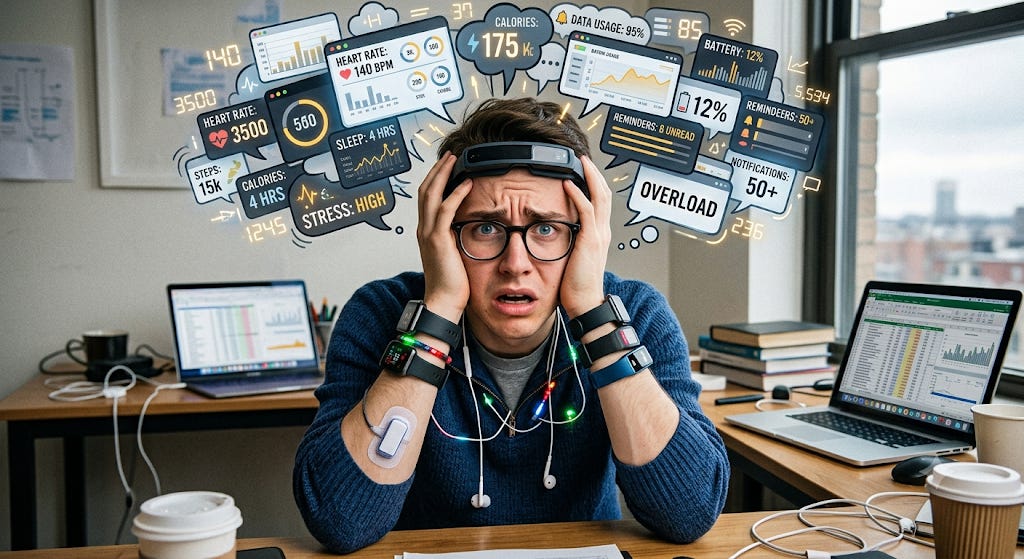
The rise in popularity of fitness & health trackers, wearables and the data from these technologies, has been matched by an increase in data overload, confusion and frustration. I believe there are a few causes, and I also think there are some solutions too.
What is causing the overload?
Too much data.
Every wearable markets and shares multiple metrics & scores, competing with other brands to offer more. But more isn’t necessarily better. I’d rather people focused on 5 metrics, and knew & understood them well, instead of getting lost in the pages of metrics & colours on different apps.
Mismatch with feel
People always expect the wearable score / data to perfectly align with feel. Whilst this can be true, it can also be false. People get frustrated and think that the data is wrong.
As an example, athletes often perceive high muscle soreness 36-48hours post muscle-damaging activity (let’s say Monday morning after a Saturday evening football / soccer match. At the same time, Monday morning’s physiology data can rebound (resting heart rate back to normal, and heart rate variability bounces back from a low the previous day). Wearables give a higher “readiness” or “recovery” score, but the athlete struggles to walk without stiffness & soreness. Neither is wrong — but the devices fail to account for subjective markers that aren’t derived from cardiovascular measures.
I’ve shared some visuals & insights on Instagram on this before:
Slow progress
People want to see rapid progress. They want to see their resting heart rate drop continuously each month. But the reality is, after an initial period of fast-gains, this will slow. A reduction in resting heart rate of 1bpm might seem trivial, but over 5 consecutive years — that is a tangible reduction in mortality risk. A lot of people ditch the wearable far before that 5 year trend is even possible to measure.
It’s also important to remember that with ageing, we typically see a regression in physiology (lower HRV, higher RHR). Another way to reframe feedback from wearables — if you are improving, or even maintaining, you are still reducing the decline that is typically seen.
Aggressive marketing & design
the overemphasis on scores (Sleep, Recovery, Readiness, Stress) without providing the ‘make-up’ of these scores. These are the first things you see, the graphs that are shared on social media, and the ones that are always in ads, on podcasts, and web searches. That doesn’t mean they hold the most value. If they did, companies would make you pay for them.
Take Oura Ring for example (a device I love and recommend). You buy their device, and they give you their scores as part of it, for “free”. But if you want to access your ‘raw data’ (resting heart rate, HRV, breathing rate, sleep duration, etc.) — you need to pay a subscription. Why would the valuable scores be free, and the ‘less valuable’ data be behind a subscription.
Read that last paragraph again.
Lack of understanding
This one might annoy some people, as consumers often want to place the blame on companies. And whilst companies are equally responsible — sometimes people just don’t know enough. We’ve had these technologies (and many others) for years, but the access used to be for professionals. Coaches & sports scientists distilled & translated the data to athletes. Doctors analysed and interpreted blood & physiology measures and made recommendations to patients. Now? We’ve skipped over the practitioners, and gone straight to consumer hands. I think this is actually great — we’ve given health & activity tracking to people that would never have considered the impact of alcohol on their sleep, or how little they were moving during the day. But we still need the person to help people interpret the data, and make the appropriate behaviour change. If you use a wearable and spend the money on it, pay a little bit more every so often to speak to a practitioner, and get the full value of the data.
(I’m biased, because I help people with this. If you want me to help you, message me and I can send you a link to book a 1-1)
Avoiding the data overload
Take a more balanced approach
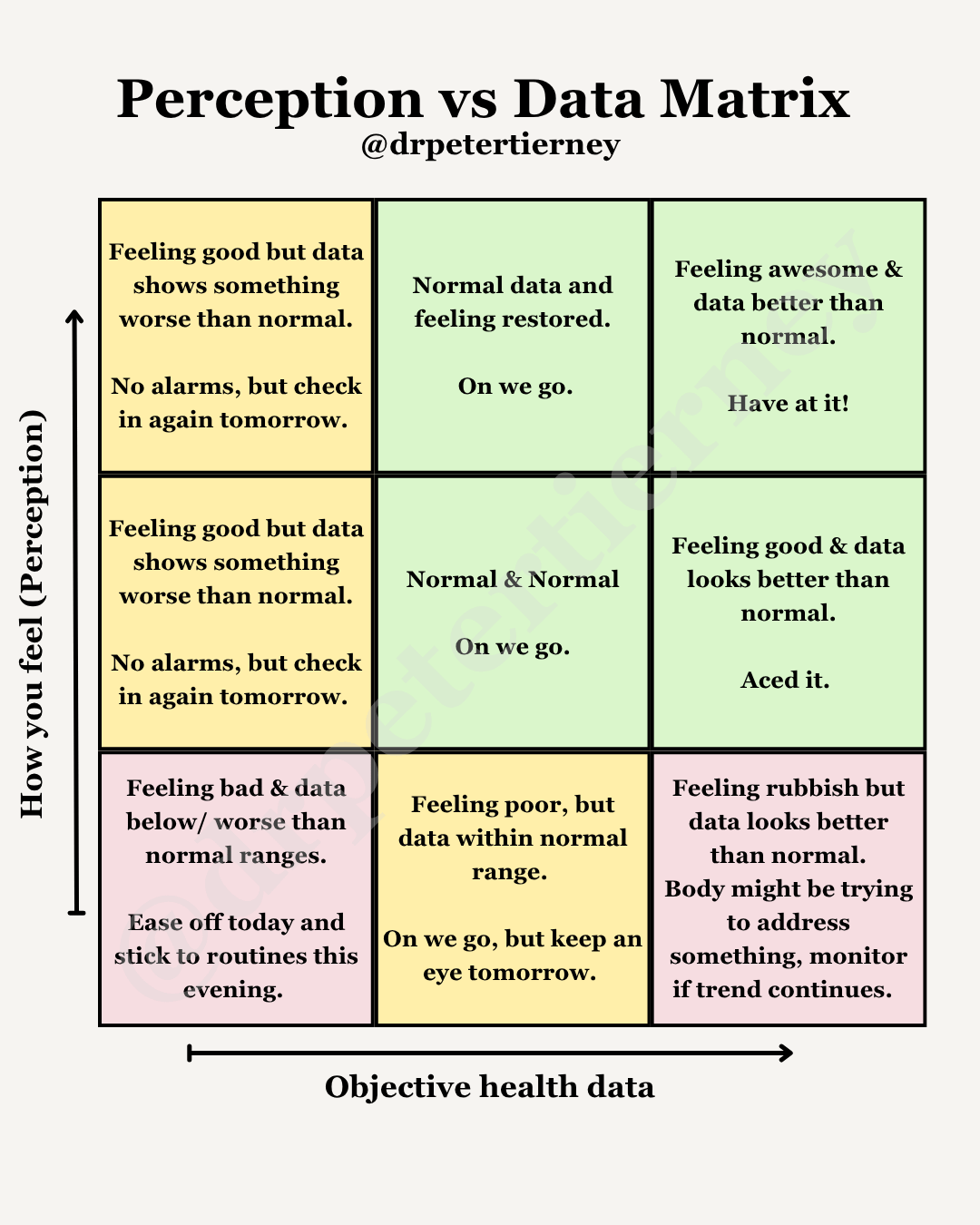
When you view any data from wearables, use that data WITH how you feel to make a decision on if you need to change anything planned today. Do you need to tweak intensity of your training? Are you sick and do you need to take a day off work and call a doctor or see a pharmacist?
Use this matrix to help you decide:
IGNORE THE SCORE
I always recommend looking at the actual data, instead of scores.
Instead of looking at your sleep score — how many hours did you sleep? How much time did you spend awake? How consistent is your bedtime and wake time?
Instead of recovery scores — what is your RHR & HRV? Are they within your normal range? How is your data trending?
Some allow you to customise or hide scores. Whoop allows you to hide scores so if you feel a little overwhelmed and want a break, you are entering into competition or match/ race day, or just aren’t that interested — you can turn it off.
Daily ‘glance’, weekly ‘check’, monthly review
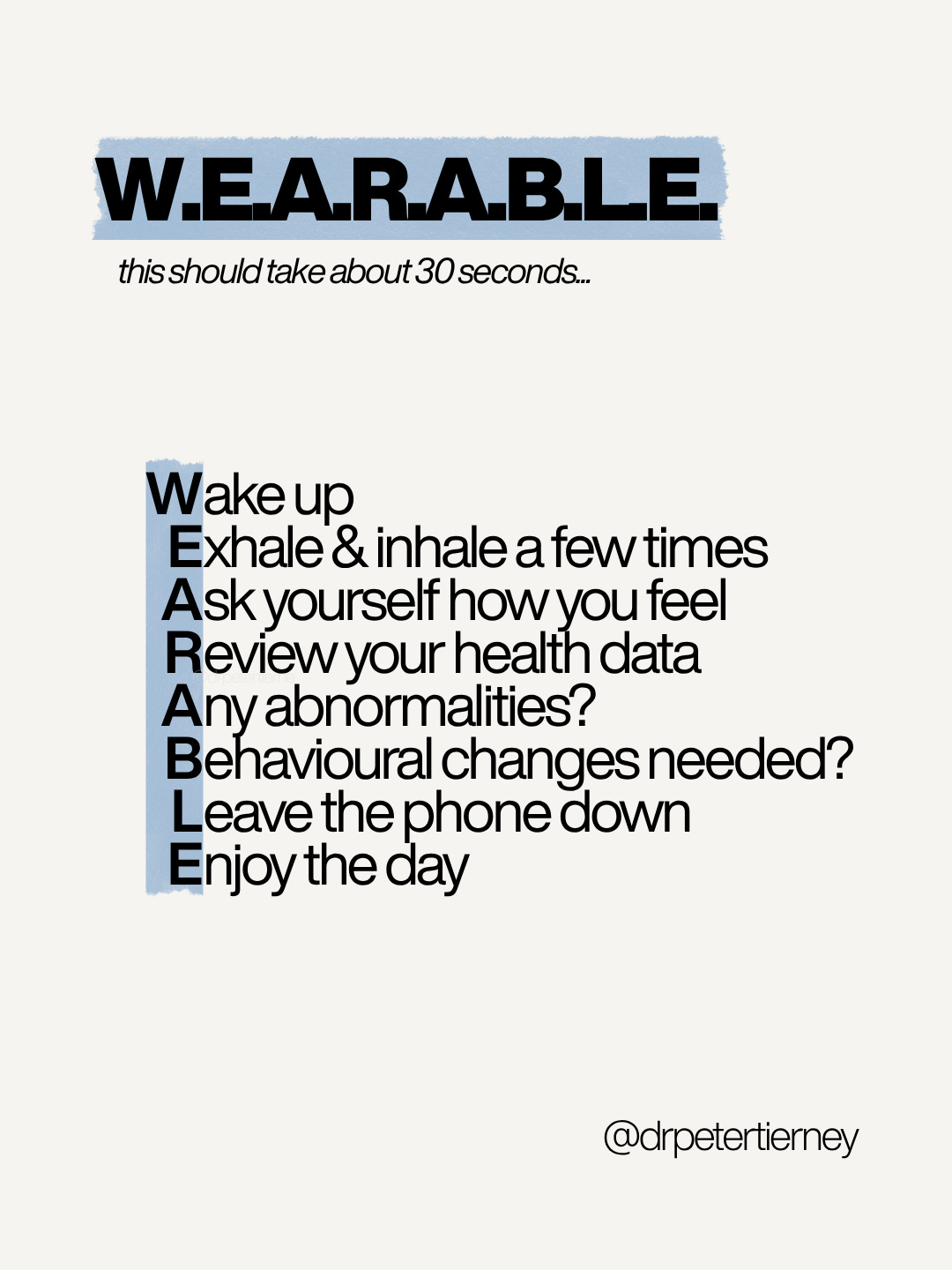
Glance at your data in the morning. Check for any large outliers in what you would expect, then forget about it. Use the wearable acronym as a process, which should only take about 30seconds.
Each week, take 5-10 minutes to review your data. Which way are you trending? Are you getting sufficient sleep? Are there things you can change to the following week? If not, that’s okay.
Each month, review your month of data. If things are still trending negatively, I’d recommend speaking to someone that can support, and also sit down to see if you can change anything in your schedule if you need to.
In a world of extremes, be balanced
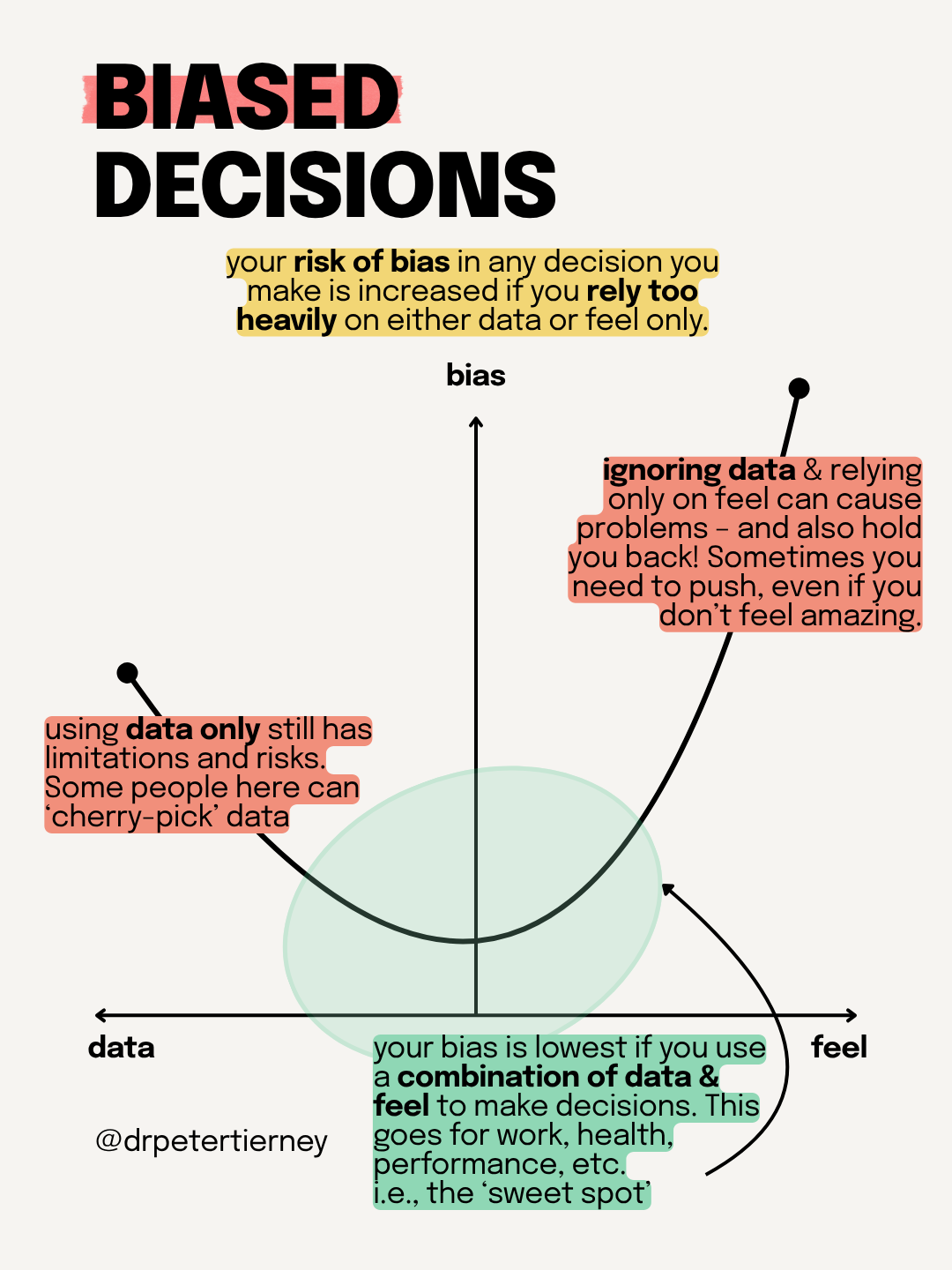
People online will always debate extremes — especially when it comes to data. People are either obsessed, or anti-data.
Wearable scores disagreeing with how you feel? The extremes are letting it control you or taking it off. The middle ground? Hopefully some of the insight in this piece has helped you better understand things.
The reality? A centred, more balanced approach is best. Sure — there will be times you may need to lean more towards data or feel. But always both.
Other content discussing over-optimisation and data overload.
Should you use a sleep tracker, from The Economist
“Optimisation culture is killing us” from Shwinnabego on Instagram
Orthosomnia post from @thebraindocs on Instagram